

Patient information is scattered across EHRs, labs, & imaging systems, making it hard for care teams to get a complete, accurate view.
Clinical data appears differently across every system, causing mismatches and errors in decision-making.
As organizations add systems and partners, integrations multiply, driving up costs, technical debt, and operational risk.
Legacy healthcare systems weren’t built for modern data sharing, limiting patient access and partner connectivity.
A centralized HL7 integration engine simplifies how interfaces are built and managed. It shortens implementation timelines & reduces the effort required for ongoing troubleshooting.
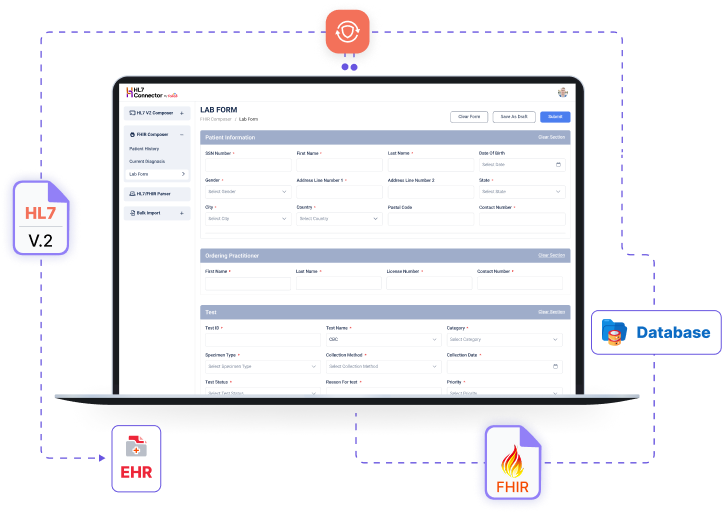
Data moves easily in both directions across systems using the FHIR & HL7 interface engine. Information can be pushed or pulled in most supported formats.
The system smoothly processes real-time bulk batch messages, keeping clinical workflows running smoothly while managing high data volumes for analytics and reporting.
Advanced data transformation normalizes messages to meet different system requirements, allowing information to convert easily between multiple data formats.
Built-in security protects sensitive healthcare data across environments through encryption, authentication, and activity logging that support stable operations.
Easy access to integration consultants helps keep systems running smoothly, with problems fixed quickly as systems grow and integrations become more complex.
Incoming HL7 messages are evaluated against configurable routing rules, including message type, patient identifiers, location, or trigger events, ensuring only relevant data proceeds.
HL7 messages are divided into a structured hierarchical model, setting segments, fields, or components for data elements to be validated, mapped, & processed.
Messages are mapped & converted across versions or industry standards, enabling alignment and interoperability between systems with differing data models.
Simpler integration management reduces maintenance effort and rework, controlling operational spending as data volumes grow.
New systems and requirements can be added without disturbing existing integrations, supporting change without complexity.
New systems, partners, and initiatives can be supported quickly, allowing the organization to adapt to evolving clinical and business needs.
An HL7 integration engine that converts raw lab data into HL7 v2 messages using state-specific rules, streamlining ELR workflows, reducing costs, and enabling real-time, standardized data sharing across health departments for improved interoperability.
HipLink needed to connect EMR systems across departments for faster, more secure alerts. We developed a robust integration that reduced data silos, enhanced communication, and helped clinical teams act faster using real-time, interoperable notifications.
Built a scheduling and billing ERP system tailored to anesthesiology practices. Enhanced workflow tracking and revenue visibility.