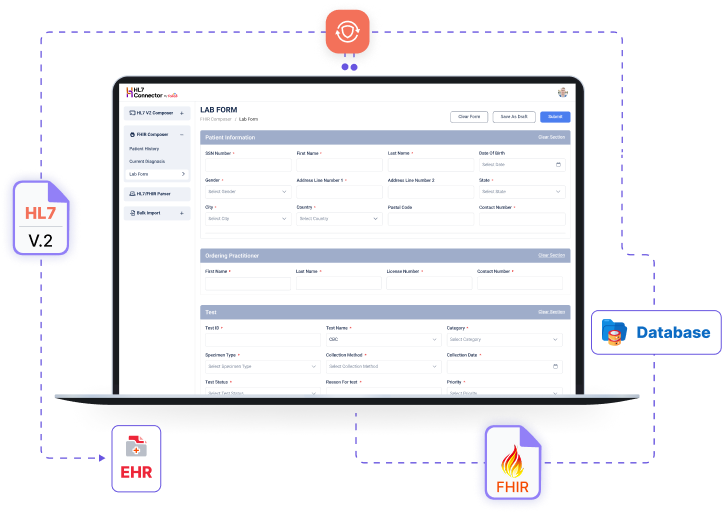


A centralized HL7 integration engine simplifies how interfaces are built and managed. It shortens implementation timelines & reduces the effort required for ongoing troubleshooting.
Data moves easily in both directions across systems using the FHIR & HL7 interface engine. Information can be pushed or pulled in most supported formats.
The system smoothly processes real-time bulk batch messages, keeping clinical workflows running smoothly while managing high data volumes for analytics and reporting.
Advanced data transformation normalizes messages to meet different system requirements, allowing information to convert easily between multiple data formats.
Built-in security protects sensitive healthcare data across environments through encryption, authentication, and activity logging that support stable operations.
Easy access to integration consultants helps keep systems running smoothly, with problems fixed quickly as systems grow and integrations become more complex.
v2.3 through v2.8 — ADT, ORU, ORM, SIU, MDM, DFT, RDE
In your data center, on your servers. You own the hardware and patching.
EPIC, Oracle Health (Cerner), MEDITECH, athenahealth, NextGen, eClinicalWorks, Allscripts
REST, messaging, and document paradigms with SMART or FHIR support
Deployed into your AWS account. PHI stays in your tenant.
Labcorp, Quest, regioral reference labs, ELR to state health departments
CDA R2 documents including CCD and C-CDA 2.1
Same model. You own the subscription; we configure the deployment.
E-prescribing networks, payer APIs, claims and eligibility clearinghouses
270/271 eligibility, 837/835 daims, 834 enrollment, 999 acknowledgment
Full GCP support, including private VPC deployment.
PACS, VNAs, DICOM modality worklists, Al inference platforms
QIDO-RS, WADO-RS, STOW-RS for imaging workflows
Listeners on-prem, processing in your cloud for systems mid-transition. Systems we connect
Continuous glucose monitors, BP cuffs, ECG patches, smart scales
2U1/0/1 and later, for pharmacy and e-prescribing
Docker images and Kubemetes Helm charts for DevOps-mature teams.
SMART on FHIR apps, CMS Patient Access, Provider Directory, Da Vinci PDex
For analytics warehouses and modern app payloads 11 here the engine runs
Immunization (VXU), syndromic surveillance, cancer registries, eCR
Our integration team builds your connections and mappings for you. There's no separate vendor to hire and no new department to staff.
A standard integration goes live in about two weeks. Most other engines take a month or two, even with an experienced team in place.
Information moves cleanly between traditional healthcare formats and modern APIs, in either direction, without custom translation code.
HIPAA, ISO 27001, and GDPR are part of the standard engagement, not an upgrade tier you have to pay extra for.
The engine runs in your own data center or your cloud account. Patient data never leaves your control.
Connect your EHR to imaging and labs for a unified, 360-degree view of every patient.
Automate the high-volume exchange of orders and results with external physician groups instantly.
Don't let technical barriers stall your growth. Use Decode Health to plug your proprietary solution into hospital systems like Epic or Cerner in weeks.
Build your product on a foundation that meets the strict interoperability standards required by large-scale healthcare institutions.
Automatically collect accurate, high-quality data from multiple trial sites to significantly speed up clinical research.
Pull data from across your entire care network to track health trends and improve community-wide outcomes.
Stream vitals and health data from patient homes directly into clinical workflows without manual data entry.
Coordinate treatment and improve outcomes by pulling consistent data from your partner institutions and support networks.
Yes. Continuous glucose monitors, blood pressure cuffs, smart scales, ECG patches, and pulse oximeters can all be normalized into HL7 v2 ORU messages or FHIR Observation resources, then routed to the EHR or to a separate analytics platform.