Recruitment-Focused Clinical Trial Management System
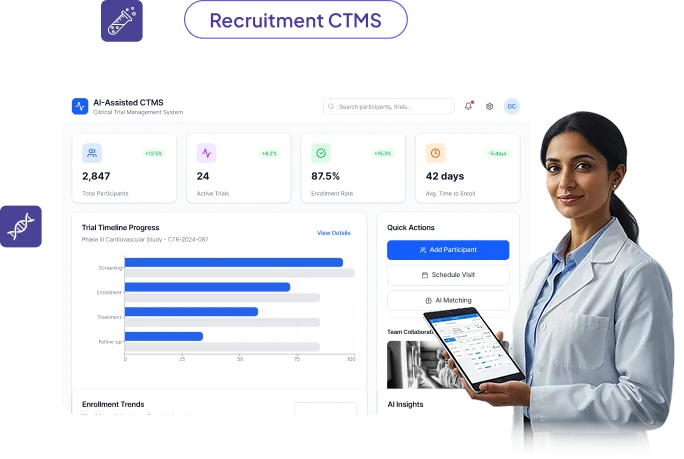
Our customizable, AI-assisted CTMS streamlines participant recruitment through smart automation. Unifying enrollment data increases visibility and makes trial timelines more predictable. This drives faster decision-making and reduces operational costs across all your multi-site clinical trials.
A healthcare research organization using CTMS software to combine clinical trial operations into one system for better compliance & visibility across multiple studies.
Enhancements
Custom recruitment workflows aligned to research team operations
AI-assisted enrollment risk detection and site performance insights
Streamlined screening, follow-ups, and coordinator task automation
Services Delivered
Recruitment workflow module customized to trial operations and study-specific enrollment needs
AI-powered tracking that uses past data to flag current site delays & predict enrollment success.
Automated screening, follow-ups, and coordinator task management across trial sites
The Tech Stack
React / Angular
Node.js / Django
PostgreSQL
Redis Cache
AWS (EC2, S3)
AI/ML models for predictive enrollment insights
Project Overview:
Nearly 80% of trials are delayed by participant enrollment roadblocks and poor site visibility. Traditional platforms use static tracking, meaning research teams can’t spot underperforming sites or screening drop-offs until timelines are already impacted.
Folio3 Digital Health’sCTMS solution improved enrollment oversight across multi-site clinical trials. It centralized data, aligned with existing trial workflows, and applied AI-assisted insights to identify recruitment risks early. This gives teams better control over participant flow, improves predictability, and reduces the cost and impact of trial delays.
The clinical trial teams faced several challenges that impacted trial timelines and costs:
Teams couldn’t easily see real-time enrollment metrics or site-level dashboards in the CTMS, making it hard to track recruitment progress or spot issues early.
Site performance data in the CTMS didn’t clearly flag slow-enrolling sites, so underperformance was noticed too late to take timely action.
The CTMS lacked timely screening status updates and automated follow-ups, causing delays in outreach and higher participant drop-off during screening.
Communication between coordinators, sites, and recruitment vendors happened outside the CTMS, relying on manual updates and creating data silos and delays.
The CTMS had limited workflow configuration and poor integration with recruitment systems, making it difficult to support flexible, end-to-end recruitment processes.
Designed a flexible sponsor-facing CTMS software around real recruitment workflows rather than rigid, off-the-shelf processes. The platform supports site-specific enrollment funnels and custom portfolio-level KPIs set by clinical operations. It centralizes study and site enrollment data from first contact through enrollment, giving clinical ops leaders clear visibility and control over recruitment.
AI-Assisted Enrollment Intelligence
Introduced AI-assisted analytics to track enrollment pace, cross-site performance, and screening drop-offs in real time. The system identified enrollment risks and slow sites weeks in advance, allowing sponsor teams to step in early and adjust recruitment efforts before timelines were impacted.
Intelligent Workflow Automation & UX Optimization
Streamlined site and coordinator workflows through automated task handoffs, reminders, and follow-ups embedded into the CTMS software. A clean, role-based interface improved site adoption and reduced manual reporting. This sped up screening and enrollment updates across all sponsor-managed studies.
Up to 40% Faster participant Enrollment Early visibility into study- and site-level enrollment metrics enabled quicker interventions and improved recruitment efficiency.
25–50% Reduction in Recruitment-Related Costs Workflow automation and earlier issue detection reduced study delays, vendor overspend, and operational overhead.
Improved Site Performance AI-assisted site performance monitoring helped identify underperforming sites sooner, improving accountability.
Higher Coordinator Productivity Simplified UX and automated CTMS workflows reduced manual coordination, allowing teams to focus on trial execution.
More Predictable Trial Timelines Enrollment risks were detected earlier, improving portfolio planning and timeline.