Automated Physician Scheduling Software for Shift Management
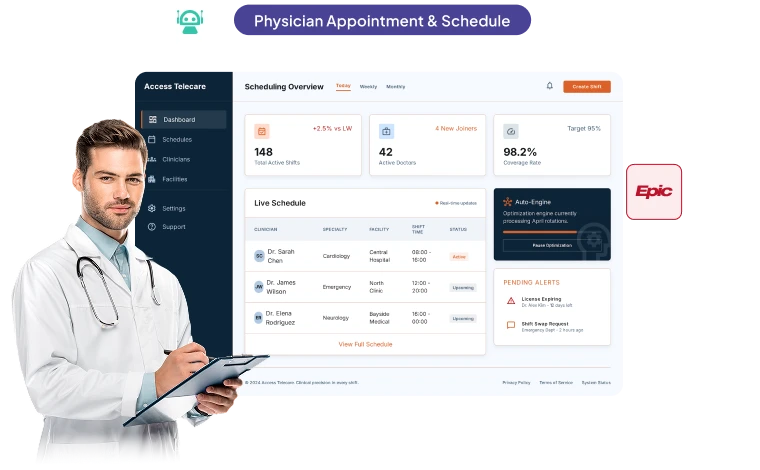
The physician scheduling platform is built to automate shift planning, eliminate manual data entry, and optimize doctor availability across multiple facilities through a custom optimization engine. It replaces error-prone, spreadsheet-based scheduling with automated data extraction, modeling, and schedule generation, helping telehealth teams manage physician shifts with far greater speed and accuracy.
A telemedicine group supporting hospitals with remote care services and automated physician shift scheduling
Enhancements
Automated Excel data extraction to remove manual entry
Custom optimization algorithm for shift allocation
Auto-generated, conflict-free physician schedules
Services Delivered
Physician scheduling workflow automation
Data modeling and optimization algorithm development
Automated schedule generation and reporting
The Tech Stack
Python
Project Overview:
Access Telecare is a group of specialists working with hospitals and outpatient clinics to provide remote care services. They partnered with Folio3’s Digital Health team to streamline their physician scheduling process. Their current process involved managing data manually, which was time-consuming and prone to human error.
Prior lessons learned from the physician scheduling systems identified an important area for improvement, the use of an automated doctor scheduler. This led to crafting the automated physician scheduling software to extract, model, and optimize data from their MS Excel sheets to manage physician and doctor shift hours effortlessly.
Challenges: The Need for Physician Scheduling Software
The client had multiple Excel sheets for various hospitals and doctors. On their road to streamlining scheduling and optimizing doctors’ shifts, they faced numerous challenges:
They relied on disparate spreadsheets that asked for manual data entry and manipulation. Entering data manually consumed valuable time and resources, hindering productivity.
Creating a timetable or agreeing to a shift swap was difficult and time-consuming, which pushed doctors toward several different communication channels, such as SMS, calls, and emails.
The manual data entry and management across a large group of hospitals, doctors, and their shift availability hindered the scalability of the scheduling process, leading to messy tracking.
Without a single system of record for doctor availability, planners had to cross-reference multiple sheets to confirm who could cover a shift.
Human error in manual tracking left room for double-booked shifts and last-minute cancellations, disrupting continuity of care.
To address Access Telecare’s challenges, Folio3 Digital Health devised a platform strategy that led to the creation of physician scheduling software:
Data Extraction
We developed tools to extract data from Access Telecare's Excel sheets. The enablement of this feature eliminated the need for manual entry.
Data Modeling
The data modeling techniques involved the analysis of historical data to identify patterns and trends that led us to develop an optimized scheduling algorithm.
Optimization Algorithm
Our team created an optimization algorithm tailored to Access Telecare's specific requirements, considering the doctor’s availability that was further split into maximum consecutive shifts and minimum consecutive days and their percent shift’s coverage.
Automated Schedule Generation
With the optimization algorithm in place, we automated the process of generating new Excel sheets with optimized care provider schedules, leaving no room for underutilized doctors.
Impact
3X Growth in Monthly Shift Capacity The automated physician scheduler helped Access Telecare significantly expand its monthly shift capacity.
Reduced Operational Costs The custom scheduling software cut costs tied to manual scheduling and administrative overhead for hospitals.
Optimized Time & Resource Utilization Automation freed up time and resources previously lost to manual data entry and shift coordination.
More Time for Patient Care Clinicians shifted focus from manual data entry to patient care, doctor support, and emergency response.
Fewer Scheduling Conflicts The solution reduced double-booking and shift cancellations caused by human error, so patients are never left unattended.