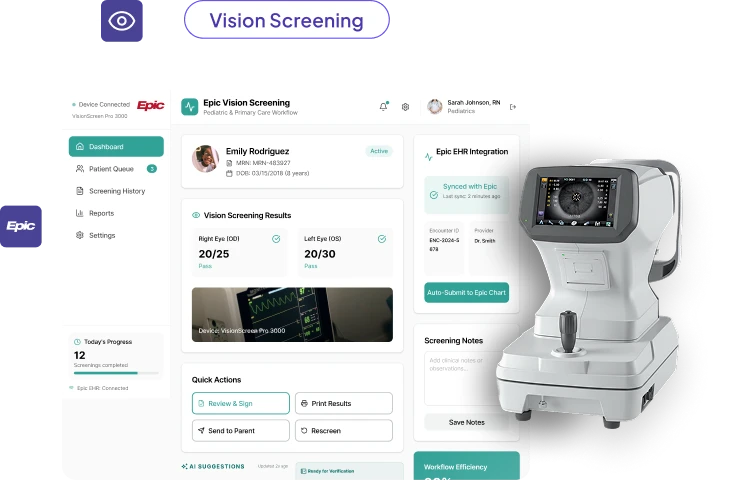
Epic Integration for Vision Screening Medical Device
A healthcare technology company partnered with Folio3 Digital Health to automate the transfer of vision screening device readings directly into Epic EHR. The aim was to eliminate manual data entry for nursing staff & lessen documentation errors across pediatric and primary care workflows.
Nurses spend a significant portion of their shifts documenting and retrieving patient data inside the EHR, reducing time available for direct patient care. In many clinics, vision screening results are still recorded on paper and manually entered into Epic Flowsheets later, creating documentation delays, transcription errors, and workflow slowdowns during high-volume patient visits.
For medical device companies, the challenge extends beyond workflow inefficiency. With Epic powering a large share of U.S. hospital systems, devices that cannot integrate directly into Epic often remain outside the clinical workflow where adoption decisions are made. Folio3 Digital Health developed a complete device-to-Epic integration that automated patient matching and vision screening data transfer directly into Epic Flowsheets, eliminating manual entry and making the solution deployment-ready for health systems using Epic.
We built a FHIR-based integration module that retrieves active Encounters and Orders directly from Epic in real time. When a patient arrives for a scheduled vision screening, the device application pulls the relevant visit context so the operator can confirm the correct patient before initiating the exam. This eliminated the guesswork and chart-matching that previously slowed down the screening workflow.
Patient-matched Screening Initiation
With encounter data now available on the connected application, the screening is initiated against a verified patient and visit, ensuring that every captured reading is accurately linked to the right individual and the correct clinical encounter within Epic. This patient-matching step prevents misfiled results, a common issue in high-throughput pediatric screening environments where multiple children are screened in rapid succession.
Automated Results Push
Once the vision screening is complete, captured readings are automatically transmitted to Epic through the HL7v2 Incoming Clinical Documentation Flowsheet Interface. The integration constructs structured HL7 messages containing the screening values and delivers them into Epic Flowsheets without any manual intervention from nursing staff.
Structured data retrieval through Epic FHIR Observation APIs
Screening results stored in Epic Flowsheets are now retrievable through Epic's FHIR Observation APIs, making them available for downstream analytics, population health reporting, and clinical decision support. Providers can view historical screening trends for a patient directly within Epic, supporting longitudinal care planning and early intervention for conditions like amblyopia or refractive disorders detected through routine screening.
Epic Community Readiness
Beyond the technical integration, Folio3 architected the solution to align with Epic's listing requirements and interoperability standards, positioning the client's product for distribution across Epic's network of hospitals and health systems.
Impact
Up to 60% Reduction in Documentation Time Automated data transfer eliminated manual transcription, freeing nursing staff to focus on patient care.
No Transcription Errors HL7 messaging removes the manual handoff between device and EHR, significantly reducing misfiled or inaccurate screening results.
2x Accelerated Screening Throughput Patient-matched encounter retrieval and automated result posting support higher patient volumes per session.
10x Improved Clinical Visibility Screening data retrievable through FHIR Observation APIs supports longitudinal tracking and evidence-based care coordination within the provider's existing Epic environment.