


















Last Updated | May 15, 2026
Epic Systems currently holds 36% of the U.S. EHR market, managing over 280 million patient records across more than 1,200 healthcare organizations.
When you look at larger facilities, this dominance is even clearer:
- 52% market share among hospitals with over 300 beds
- 71% market share in major academic medical centers
This high concentration isn’t an accident. IT leaders consistently choose Epic because of its reliable total cost of ownership, deep clinical integration, and guaranteed implementation. While cloud-native competitors promise faster setups, major health systems prefer to expand their proven Epic infrastructure rather than gamble on new alternatives.
Why Is Epic a Safe Choice For Hospitals?
Large health systems prioritize operational reliability and clinical safety over flashy innovation. When running a 600-bed academic medical center, leadership needs a system that handles mission-critical tasks in under 30 seconds, such as:
- Routing a trauma patient to the correct bay.
- Flagging immediate surgical availability.
- Pulling cross-matched blood products.
- Alerting the pharmacy to prep medications.
Epic performs these complex tasks reliably across more than 3,600 hospital installations in the United States. This reliability is exactly what separates world-class trauma care from average care.
Buying an EHR means building an operational infrastructure meant to last 10+ years. Epic was built to handle this messy reality, seamlessly juggling multiple specialties, complex billing, teaching requirements, and integrations with outdated legacy systems (like radiology software from 1998). Competitors, by contrast, were built for simpler environments.
Clinician-Engineered Workflows & Guaranteed Rollouts
Epic’s workflows were designed by actual clinicians. A lung specialist logging in doesn’t start with a blank slate; they immediately find pre-loaded, evidence-based templates for COPD, pneumonia, and mechanical ventilation. This means hospitals start with decades of embedded clinical knowledge right out of the box, drastically speeding up physician adoption.
When it comes to rolling out the software, predictability is crucial for a hospital board committing $50 to over $200 million and facing 18 to 24 months of disruption. According to KLAS Research, Epic was selected for 108 hospitals by 10 large health systems in 2024 alone — its largest net gain on record. The same KLAS report notes that Epic won nearly 70% of all hospitals, regardless of size, impacted by EHR decisions in 2024, a track record that comes from a reputation for partnership and reliable delivery.
The Power of Network Effects
Replacing Epic is a massive infrastructure decision. For a 350-bed system with 12 hospitals and 47 affiliated practices, switching costs are substantial; large health systems regularly invest $50 million to over $200 million for Epic deployments, and recent large-scale projects have run even higher: University Hospitals in Cleveland budgeted roughly $400 million for its Epic install, and Memorial Hermann Health System’s 2024 Epic implementation was reportedly $500 million.
As a health system acquires new clinics and urgent care centers, the cost of switching grows exponentially. By year five, a hospital might have dozens of custom integrations and thousands of trained staff members. Replacing that at year ten requires massive retraining and operational downtime.
To support this growth, Epic has an unmatched system of integration partners. As of April 2026, more than 1,000 apps are listed in Showroom, Epic’s marketplace for products that connect with Epic. Whether connecting a medical device or migrating old lab data, hospitals can rely on partners with deep, vetted Epic integration experience.
The 2026 Roadmap: Fixing Burnout
Critics rightfully point out that EHRs cause physician burnout. According to the American Medical Association’s 2025 Organizational Biopsy, 41.9% of physicians reported at least one symptom of burnout in 2025, and ineffective EHR systems were among the most cited sources of physician job stress.
It was found that physicians identified administrative tasks like charting and paperwork as burnout contributors. However, Epic’s 2026-2027 roadmap directly addresses this with massive quality-of-life updates:
- Faster Notes (Ambient AI): A 2025 JAMA Network Open quality improvement study of 263 clinicians across six health systems found that after 30 days using an ambient AI scribe, burnout among ambulatory clinicians dropped from 51.9% to 38.8%, with significant improvements in time spent documenting and cognitive task load.
- Fewer Alerts: AHRQ has documented that primary care clinicians can receive more than 100 alerts per day, contributing to alert fatigue. Intelligent optimization in modern EHRs aims to suppress low-value alerts while preserving critical ones.
- Better Interface: Rebuilt with actual clinician input, the new UI features a cleaner inbox, fewer clicks for medication orders, and note templates that match how doctors actually think.
A hospital buying Epic today is buying immediate access to this pipeline of improvements.
Cloud Adoption and Open Standards (FHIR)
Epic now offers full cloud deployment through its formal partnership with Microsoft Azure, with the same clinical workflows, meeting strict HIPAA, HITRUST, and SOC 2 standards. Small hospitals can choose the cloud, while large centers can keep data on-premise.
Epic has also adapted to open standards. According to the Assistant Secretary for Technology Policy (ASTP/ONC), 70% of non-federal acute care hospitals enabled patient access via apps configured to meet FHIR specifications in 2024, and hospitals using the market-leading EHR developer had significantly higher FHIR app access rates (83%) than hospitals on other EHRs (56%). Now, hospitals can build highly flexible point solutions while keeping Epic as their stable, central hub.
Epic Integration with Folio3 Digital Health
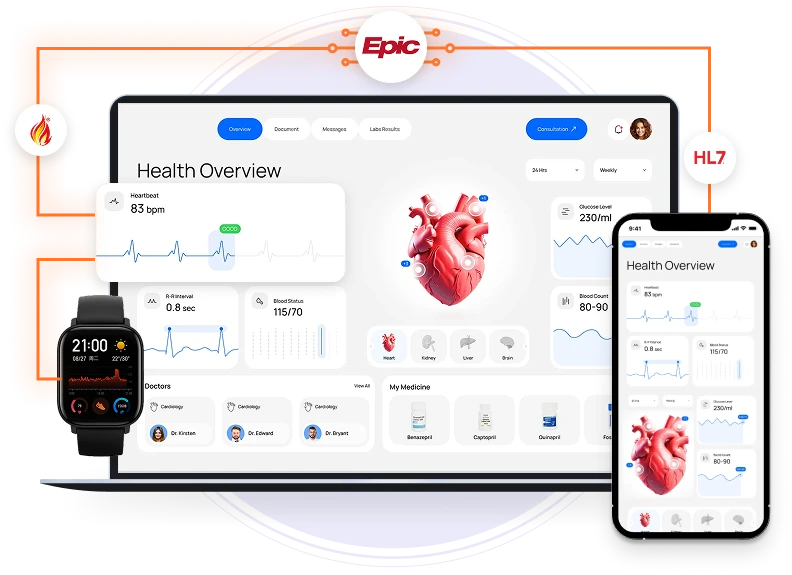
Because Epic is so dominant, there is a huge demand to connect it to outside devices and legacy software. This is where Epic Vendor Services members like Folio3 Digital Health make Epic even stronger by building FHIR-standard bridges through their Epic Integration Services. Epic device integrations are typically a six-figure investment per device class. Folio3’s Epic Integration Services offer pre-built connectors that reduce the spend significantly.
Closing Note
For a large health system, replacing Epic simply makes no sense. The switching costs and implementation risks are too high.
Mid-size systems (100–300 beds) or small practices might explore cloud-native alternatives. But if you run an academic center or manage a complex 300+ bed facility, Epic remains the undisputed incumbent.
Epic’s market share is consolidating. Epic now commands 42.3% of the acute care EHR market and 54.9% of acute care hospital beds. With better cloud options, improved interoperability, and massive upgrades to the physician experience arriving in 2026, Epic remains the most rational, proven choice for risk-conscious IT leaders.
Frequently Asked Questions
How Long Does an Epic Implementation Actually Take?
Standard implementations run 18–36 months, depending on complexity. According to multiple Epic implementation guides, Epic’s implementation is resource-intensive, typically requiring 12–24 months for a single hospital with significant productivity dips during go-live.
What Prevents Physician Burnout During Epic Implementation?
Clinical workgroups redesigning workflows 6-9 months before go-live (co-design, not training) and 2-3 hours weekly “optimization sprints” post-go-live, where IT fixes workflow friction immediately. Recent evidence supports this: a JAMA Network Open quality improvement study found that after just 30 days with an ambient AI scribe, burnout among ambulatory clinicians dropped from 51.9% to 38.8%. Physicians burn out from slow support systems, not Epic itself.
What’s Epic’s AI Roadmap for 2027-2029?
Three main areas. First, AI-generated clinical documentation from voice. A recent multi-site study of 1,800 clinicians across five academic medical centers found that AI scribes saved roughly 16 minutes of documentation time per eight hours of patient care, and a longitudinal Abridge-on-Epic study reported approximately a 15% reduction in documentation time sustained over 150 days. Second, automated prior auth and insurance verification. Then, predictive deterioration alerts are integrated into nursing dashboards.
About the Author

Shalin Amir Ali
I am a Software Engineer specializing in digital health technologies, developing secure, cloud-based applications for telemedicine, health tracking, referral management, DICOM viewer applications for medical imaging, and HL7/FHIR integration. Passionate about AI-driven diagnostics and health informatics, I build solutions that enhance patient care and optimize clinical workflows. With expertise in Python, .NET (C#), React.js, Next.js, TypeScript, and JavaScript, I create scalable healthcare applications that seamlessly integrate with modern ecosystems.