




















HL7 Integration
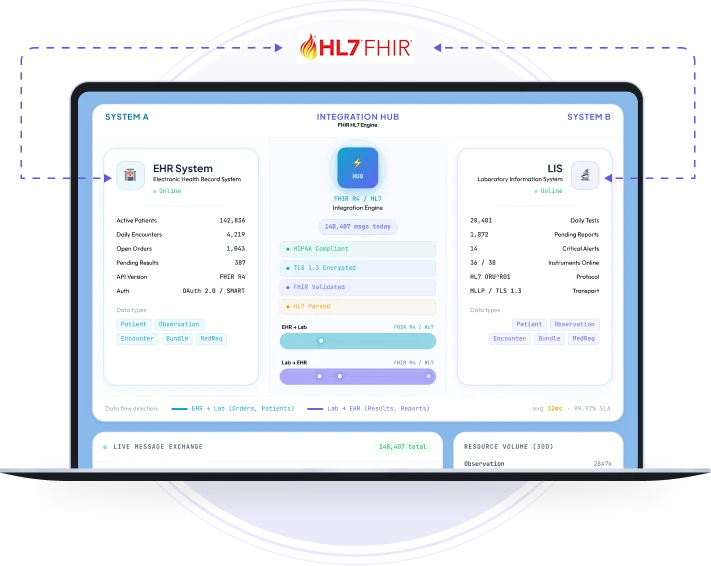
We build and maintain HL7 interfaces for ADT, ORU, ORM, and scheduling messages between your current systems.
 Sub-Services include:
 EHR/EMR interface builds for admissions, orders, and results
- CCD and CDA clinical document exchange
- Shared clinical context across applications, so a clinician doesn't have to re-select the same patient in every system (CCOW, MLM)
- HL7 v2/v3 message parsing, validation, and error handling
- Real-time web service support for clinical decision support tools
- Interfaces for labs, imaging, e-prescribing, devices, and billing systems

FHIR Integration Services
We turn your existing data into FHIR resources that follow US Core and payer-specific profiles, so the data means the same thing on both ends of the exchange.
Sub-Services include:
- Mapping your existing data fields to the right FHIR resource types
- End-to-end FHIR R4 implementation built around your actual workflows, not a generic template
- Cleaning up inconsistent formats across EHRs, labs, payers, and apps before they hit your FHIR layer
- Real-time care coordination enabled through FHIR APIs, not batch file drops
HL7-to-FHIR Data Interoperability
We build the pipelines that move data between HL7 v2 and FHIR without losing meaning, across multiple EHRs at once.
Sub-Services include:
- Converting messages back and forth between HL7 v2 and FHIR without losing fields
- Running Epic, Cerner, Meditech, and other EHRs side by side during a transition
- Support for TEFCA, USCDI, and CMS interoperability requirements
- Moving legacy data over without a hard cutover date
FHIR APIs for Apps, Payers & Partners
We build FHIR APIs that let your EHR, payer systems, and partner apps request exactly the data they need.
Sub-Services include:
- Support for apps that launch inside your EHR window (SMART on FHIR)
- Payer-to-payer and provider-to-payer API pathways
- Bulk data export (Flat FHIR) for population health and analytics
- Secure, role-based access control with OAuth 2.0 and OpenID Connect
FHIR Security, Compliance & Consent Management
We build access control, consent capture, and audit logging into the integration itself, not as an afterthought.
Sub-Services include:
- HIPAA and CMS-aligned architecture
- Encryption and access control built on OAuth 2.0 and OpenID Connect
- Patient consent capture and enforcement
- Full audit trails and activity logging
- Secure de-identification of data for research use
FHIR Interface Engine Configuration
We configure and run interface engines that handle your message volume without dropping data.
Sub-Services include:
- Mirth Connect, Rhapsody, Iguana, and InterSystems configuration
- Custom FHIR interfaces for EHRs, labs, payers, and health apps
- Direct integration with your HIS, PMS, and billing platforms, not just the EHR
- Real-time monitoring and error recovery for high-volume message flows
HL7 Integration Monitoring & Support
We watch your interfaces after go-live, so you find out about a failed message from a dashboard, not from a clinician.
Sub-Services include:
- Interfaces watched around the clock, not just during business hours
- Alerts that tell you which message failed and why, not just that something did
- A dashboard that shows you where a bottleneck actually is, for faster issue resolution
- Interface maintenance as part of the ongoing relationship, not a separate line item
Custom Healthcare Integration Workflows
We don't focus on moving messages, but our HL7 integration services yield workflows that fit how your specialty works. From a lab order all the way through to the billing trigger it creates.
Sub-Services include:
- Specialty-specific workflow configuration across the clinical and revenue cycle
- Lab-order-to-billing-trigger automation that removes duplicate data entry
- Fewer manual handoffs between departments, fewer chances for a field to get missed
EHR Data Migration
When you're switching or consolidating EHR systems, normalization is where data usually gets lost; our HL7 FHIR integration services build that step to hold up.
Sub-Services include:
- Normalizing HL7, FHIR, CCD, and CCDA data across multiple source systems
- Migration timelines built to avoid gaps in clinical continuity
- Data-loss checks run before and after cutover, not just at the end
FHIR Server Implementation
We deploy and tune FHIR servers on the infrastructure that fits your environment, cloud or on-prem.
Sub-Services include:
- AWS HealthLake, Azure Health Data Services, Google Cloud Healthcare API
- On-prem, hybrid, or fully cloud-hosted, depending on what your infrastructure team wants
- Secure storage and fast retrieval of FHIR R4 resources at scale
- Tuning for faster query response times as your data volume grows
FHIR-Native App & Platform Development
Our HL7 FHIR interoperability services include building a full product built on FHIR from scratch.
Sub-Services include:
- Health information exchange (HIE) and clinical data repository builds for population-level data
- Patient and provider portals that read and write FHIR directly
- Analytics and BI dashboards fed by live FHIR data
- Clinical decision support embedded inside the existing EHR workflow
- Claims, billing, and revenue cycle tools that pull structured data instead of re-entering it
FHIR Data Analytics
Once your data is structured in FHIR, it will be a step forward. Not mere exchange; our FHIR integration services help you build reporting on it.
Sub-Services include:
- Operational and clinical KPI dashboards built directly from FHIR resources
- Predictive denial and claims trend analysis using your normalized data
- Population health and outcomes tracking using bulk FHIR exports
- Custom reporting for quality measures
HL7/FHIR Advisory & Roadmapping
We help you map the path from where you are now to a working FHIR integration services program.
Sub-Services include:
- An honest read on where your current setup actually stands, not a checklist score
- Strategic planning for how you move from HL7 to FHIR, on your timeline
- Help picking between interface engines when you're not sure which one fits your volume
- Training your in-house team so they're not stuck calling us for every small change



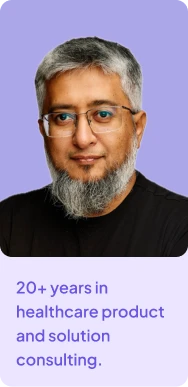
Muhammad Abdullah Sabooani
Vice President | Folio3 Software®
Muhammad Abdullah Sabooani Vice President | Folio3 Software®
Leads digital healthcare at Folio3 Software, helping healthcare and healthtech companies turn complex technology needs into working products. He brings 20+ years of experience across enterprise software and digital product delivery, including work with organizations such as Zoetis, Sony, and Disney.
As Vice President, he leads healthcare technology engagements from solution planning through delivery, with a focus on integrations, mobile products, AI, and user experience.
View Profile

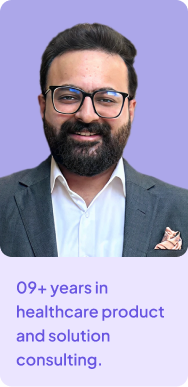
Abdul Moiz Nadeem
Senior Product Manager, Folio3 Digital Health
Abdul Moiz Nadeem Senior Product Manager, Folio3 Digital Health
Abdul Moiz Nadeem works with healthcare organizations and health technology teams to find where their clinical and operational systems break down, then build what fixes it. Nine years in healthcare product and solution consulting.
it. Nine years in healthcare product and solution consulting.
At Folio3 Digital Health he leads discovery for integration and imaging engagements, mapping workflows with clinical and IT stakeholders, defining pilot scope, and staying on through UAT, deployment, and production
it. Nine years in healthcare product and solution consulting.
View Profile
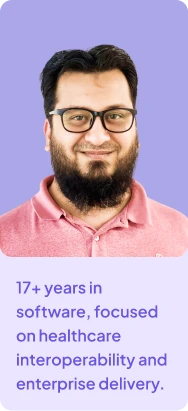
Muhammad Usman Aleem Program Manager & Practice Director, Folio3 Digital Health
works at the point where healthcare systems have to communicate to each other, closing the integration gaps that break when they don't. 17+ years in software, the last several in healthcare technology.
At Folio3 Digital Health he leads delivery for interoperability and enterprise healthcare engagements, scoping Epic and EHR integrations, running cross-functional teams, and solving the data-mapping problems that break them.
View Profile

Muhammad Usman Aleem
Program Manager & Practice Director, Folio3 Digital Health
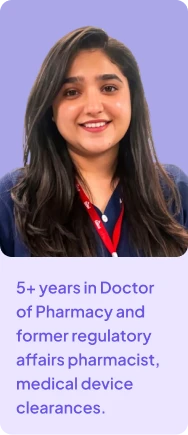
Iffat Jamal Pharmacist | Healthcare Domain Expert | Folio3 Digital Health
Iffat Jamal brings a pharmacist’s perspective to digital health, connecting clinical context with the regulatory requirements behind healthcare products. With a Doctorate of Pharmacy and regulatory affairs experience, she understands how healthcare technology, medical devices, and product claims are evaluated.
At Folio3 Digital Health, she works across regulated health products, shaping content and demand generation around accuracy, compliance, and bringing healthcare technology to market.
View Profile

Iffat Jamal
Pharmacist | Healthcare Domain Expert | Folio3 Digital Health

Dean and Ayesha Sherzai
Founders of The Neuro Plan
Team Folio3 brought my dream app to reality, they explained every step to our non technical team professionally. wireframe and design processes were outstanding & they built stunning and perfectly integrated application. I think both patients and clinic will be significantly benefited.

Elizabeth Miazga
MD FRCSC at Saint Michael's Medical Center

Tracey Hawkins
Founder and CEO at Thriving on the Spectrum, LLC


Justyna Wilson
Senior Director eCommerce and Marketing at face reality Skincare
Working with the folio3 team has been a great experience. Your dedication, creativity, and adaptability in overcoming challenges for the Moodology app project are truly commendable.

Azhar Ali
Director At AiGenics

Omar Ali Midani
Co-Founder and President at PureLife Dental
I appreciate your remarkable work during the recent Laboratory service phase. Your determination, analytical thinking, and continuous efforts were crucial in overcoming challenges and achieving success. I appreciate your help as we collaborate to create fantastic items.

Maker Athian
Founder at iVision
Kudos to your team for outstanding work in the discovery phase! Your team understood our business and workflows by asking the right questions and extracting the most useful information. Your team's ownership and results-oriented approach are commendable.

Shaukat Zakaria
CEO at HealthQuest