FHIR Integration Partners

Build & Scale FHIR Integrations for Modern Healthcare

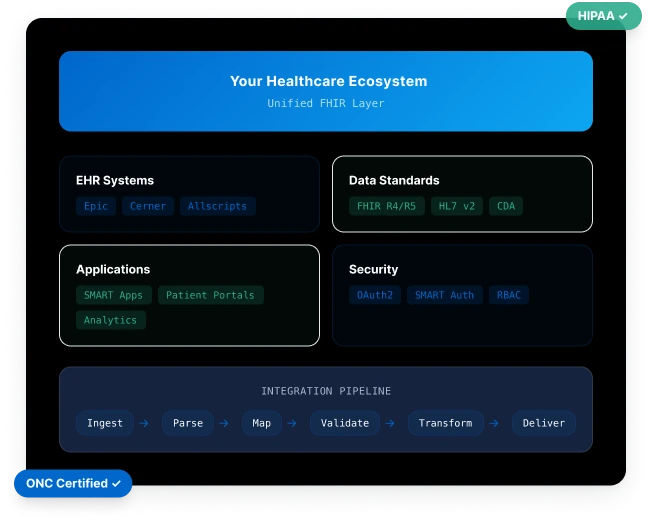
Design and implement production-grade FHIR APIs (R4/R5), SMART on FHIR applications, and FHIR interoperability workflows across EHRs, devices, and third-party systems — built with secure OAuth2 authorization and real-world integration constraints in mind.

Trusted By
Enterprises & Startups

What's Stopping You from Achieving FHIR Integration?

Healthcare organizations lose time and budget battling fragmented data, legacy protocols, and integration complexity.

Fragmented EHR Data

Patient data trapped in silos across incompatible systems, making unified access nearly impossible.

No Standardized APIs

Patient data trapped in silos across incompatible systems, making unified access nearly impossible.

Limited SMART on FHIR Expertise

Without in-house expertise in SMART launch protocols and OAuth2 scoping, building EHR-integrated apps becomes a costly trial-and-error process.

Legacy HL7 Burden

Outdated HL7 v2 interfaces add complexity, cost, and latency to every integration project.

Slow Integration Timelines

Manual mapping and testing cycles stretch healthcare integration projects from weeks into months.

FHIR Integration Services Built for Modern Healthcare Systems

From API development to full interoperability consulting — everything your team needs to build, connect, and scale healthcare applications.

FHIR API Development

SMART on FHIR Applications

FHIR API Development

HL7 ↔ FHIR Transformation

Middleware & Connectors

FHIR Implementation Capabilities

Implementation-level expertise across the FHIR specification, HL7 messaging, and healthcare API standards.

FHIR R4 / R5 API implementation

HL7 v2 parsing — PID, OBX, MSH segments across ADT, ORU, ORM messages

RESTful API design, endpoint orchestration, and bulk data handling

FHIR validation, conformance testing, and profile enforcement

Analyze

Design

Implement

Validate

Deploy

How FHIR Integration Works — From Assessment to Production

A structured, implementation-focused approach — from system analysis through production deployment.

01

System & Data Analysis

Evaluate source systems (EHRs, LIS, RIS) and data formats — HL7 v2, CDA, existing FHIR APIs — to define integration scope.

02

FHIR Architecture Design

Define resource models (Patient, Observation, Encounter), API contracts, authorization flows, and interoperability workflows.

03

Implementation

Develop FHIR R4/R5 APIs, HL7 v2 transformation logic, and middleware layers with error handling and retry mechanisms.

04

Validation & Testing

Perform FHIR conformance validation and integration testing with EHR sandboxes — Epic, Cerner — including rate-limit simulation.

05

Deployment & Monitoring

Deploy with structured logging, performance monitoring, audit trails, and ongoing optimization for production workloads.

Case Study

Epic Integration for the Alert Management Platform

Healthcare integrations that streamline communication and automate alerts, ensuring faster response times and improved efficiency for providers.


Why Folio3 Over Generic Integration Platforms

We’re not just a tool — we’re your FHIR integration partner with deep healthcare expertise.

Capability

Folio3

Generic Engines

Custom FHIR API Development

End-to-End Delivery & Support

Healthcare Domain Expertise

UX & Product Strategy

SMART on FHIR App Enablement

Custom Middleware & Connectors

Integration Engine Only

Consulting + Implementation

Get Started

Get Your FHIR Integration Plan

Tell us about your healthcare integration needs and our FHIR experts will build a custom roadmap for your team.

    Frequently Asked Questions

    What is FHIR integration?
    FHIR (Fast Healthcare Interoperability Resources) integration is the process of connecting healthcare systems using the HL7 FHIR standard — a modern, RESTful API-based approach to exchanging clinical data. It enables real-time, standardized access to patient records, lab results, medications, and more across EHRs and health applications.
    HL7 v2 is a legacy messaging standard that uses pipe-delimited formats and requires custom parsing. FHIR is a modern API standard built on REST and JSON, making it far easier to implement, test, and scale. FHIR supports web and mobile applications natively, while HL7 v2 was designed for point-to-point system messaging.
    SMART on FHIR is a standards-based framework for building healthcare applications that can launch within EHR systems. It combines FHIR APIs with OAuth2 authorization, enabling secure, portable health apps that work across multiple EHR platforms like Epic, Cerner, and others.
    Yes. Folio3 has deep experience integrating with Epic’s FHIR R4 endpoints, including patient access APIs, clinical data APIs, and SMART on FHIR app launches within Epic’s ecosystem. We also work with Cerner, Allscripts, and other major EHR platforms.
    Not necessarily. While integration engines serve a purpose for certain use cases, Folio3 provides a full-service approach — custom FHIR API development, data transformation, custom connectors, middleware layers, and implementation consulting — without requiring you to license and maintain a separate integration engine.
    Timeline depends on scope and complexity. A focused FHIR API integration can be delivered in 4–8 weeks, while enterprise-wide interoperability projects may take 3–6 months. Our team provides clear roadmaps and phased delivery to ensure fast time-to-value.

    Start Building Interoperable Healthcare Applications with FHIR

    Partner with Folio3 to accelerate your healthcare API strategy — from architecture to production.

    Help Us Understand — What Held You Back?

    Can you tell us what stopped you from contacting us?